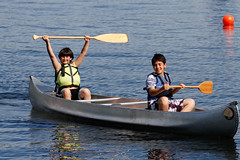
As parents, we are always on the lookout for experiences that help our children learn new skills. We enroll them in music lessons, martial arts, sports, theatre, choir and, of course, summer camps. But we all know that the best programs (and the best educational experiences) are ones that go beyond the basics of teaching skills to help develop our children’s character. The basics of character — trustworthiness, respect, responsibility, fairness, caring and citizenship — are all essential ingredients in summer camp experiences.
“Camp teaches values such as self-esteem, teamwork, and caring — areas where traditional schools sometimes cause more detriment than good. And camp allows everyone, not just the top student and the best athlete, to thrive and enjoy the process of learning,” says Peg Smith, CEO of the American Camp Association (ACA).

Everything we’ve written about on this blog so far — being ready for camp, unplugging from the digital world, traveling to camp, developing interpersonal communication skills, interacting with camp counselors, participating in camp traditions, and learning new sports and skills all contribute to building character.
When mom Martha realized that her son Jaden had come home with crucial life skills — taking care of himself and making good choices — she knew that camp had served a crucial role in his life.
“I felt like they were living a free life,” she says. The rules were there, just not stressful. This kind of independence creates the necessary space for the foundations of character to blossom. “I could not believe the person he had become – just a new person – totally confident in himself,” she says.
It’s no surprise, really. Camp activities, to be successful, require all the participants to have self-discipline and an unselfish sense of camaraderie. “There is just something about living with a group of boys,” mom Wendy says after sending her only son Justin to camp for the first time. Living communally in cabins and bunks requires teamwork, creativity and a willingness to work together.
The camp directors, staff and counselors deserve much of the credit for the character development Martha and Wendy saw in their sons after just a few weeks at camp. They work hard to develop programs that bring a diverse community together around common values and goals, and everyone benefits – campers, parents and staff, and the world they come back to each fall, bringing their good character with them. Camp is about educating the whole child and allowing them to flourish, so that we all as a society may do so.
Olivia, Guest Contributor

In
If you’re in Louv’s age bracket, you may also recall a childhood filled with a kind of free, natural play that today seems like an antique artifact compared to current kid’s lives. Lives filled with mobile devices, instant messaging, screen time, digital games and fears of “things” outside. In his book, Louv explores “the increasing divide between the young and the natural world, as well as the environmental, social, psychological, and spiritual implications of that change.” He discusses the accumulating research that implies that secure children (and adults for that matter) must connect with nature to fully develop. This need for contact with the natural world is as imperative as good nutrition and adequate sleep. So, while multiple reasons give us less and less time to connect outdoors, more and more studies suggest that embracing nature is a human necessity.
Louv discovered that 
As children mature, they continue to develop and require more experiences where they can make independent choices without parents. If parents don’t allow children to make decisions and do things on their own, they won’t develop confidence or realize that they are not just extensions of their caregivers. It’s a tricky line that parents walk! Sometimes giving children room to spread their wings seems counter intuitive, but in order to grow into a self-reliant adult, children need to struggle without the offer of a quick fix. Even when parents can take care of things, the better choice is to support a child through the process of working through and solving problems. Long after a problem has been forgotten, a self-reliant child will remember hearing, “Wow! You amaze me! You really worked hard to figure that out.”
Of course, the
According to the
Cabinmates must also learn how to navigate the waters of communal decisionmaking. They must work through the inevitable issues and conflicts that come up in cabin living — and they must learn to adapt and get along when things don’t go their way. They learn to live by the will of the majority, while at the same time respecting the needs of others who represent the minority. Again, according to the
Although sometimes I am annoyed with how much of my life occurs online, there’s no arguing that modern social networking has helped nurture the lifelong friendships developed at camp. Now, instead of waiting days or week from a letter from a camp pen pal, you can send a text message, IM, or just nudge them on Facebook. Many camps have Facebook groups, some devoted exclusively to alumni from certain years, so the 50-somethings reminiscing about camp in the 70s can be a subgroup of a larger online camp community.
In an earlier post, we discussed one of the primary concerns parents have about summer camp – will my child be safe? This week, we wanted to talk about the people who care for our kids at camp and keep them safe; how they are chosen and trained to do their jobs. When you’re putting the care of your children into other people’s hands, it’s important to have confidence in their caretakers. At Laurel South, not only does every person who works at camp have to love working with kids, they all also have to be good at it and have the skills to be a success.
Of course, selecting the right people is only the beginning of the process of creating a successful staff. The counselors must also be trained and oriented to the camp’s particular processes, schedules and procedures. To do so, all staff must complete a week-long Orientation. We are especially lucky to have large groups of former campers who return to be counselors. They know the camp traditions and songs, and, more importantly, they remember what camp looks like from the point of view of the campers. At Orientation, they can share their experiences with new staff members and serve as ambassadors for our particular mission and traditions.
Beyond the formal week long Orientation, over half of the individual activity instructors (waterfront, rock climbing, mountain biking, etc.) come to camp early, with key staff and counselors often training three weeks prior to Orientation. Counselors who are responsible for specific program areas are also trained to write lesson plans and taught how to execute a fun and instructional activity period. Each attends an entire training day devoted to teaching kids their particular activities and making it fun. Finally, every camp staff member is well-trained in general safety procedures and first aid, with additional courses and certifications dependent on counselor responsibilities.
Even when you are right there next to your child to offer comfort, care and treatment, accidents and injuries can be difficult to deal with. So as we prepare our kids to go to summer camp, it is important to ask some questions of the camp and prepare our children well. That way, everyone can rest assured they are having a summer of fun and making memories to last a lifetime in a safe environment.
Camp requires staff safety training.
Understand which kinds of behavior are acceptable and which aren’t. Breaking the rules can put others in dangerous situations.